



At 9:17 p.m., the ED is one bed away from gridlock.
It’s not that you’re short on clinicians. It’s not a lack of effort. You’re missing the most expensive resource in hospital operations: physical capacity.
And that’s where a question that no longer sounds futuristic—only operational—shows up:
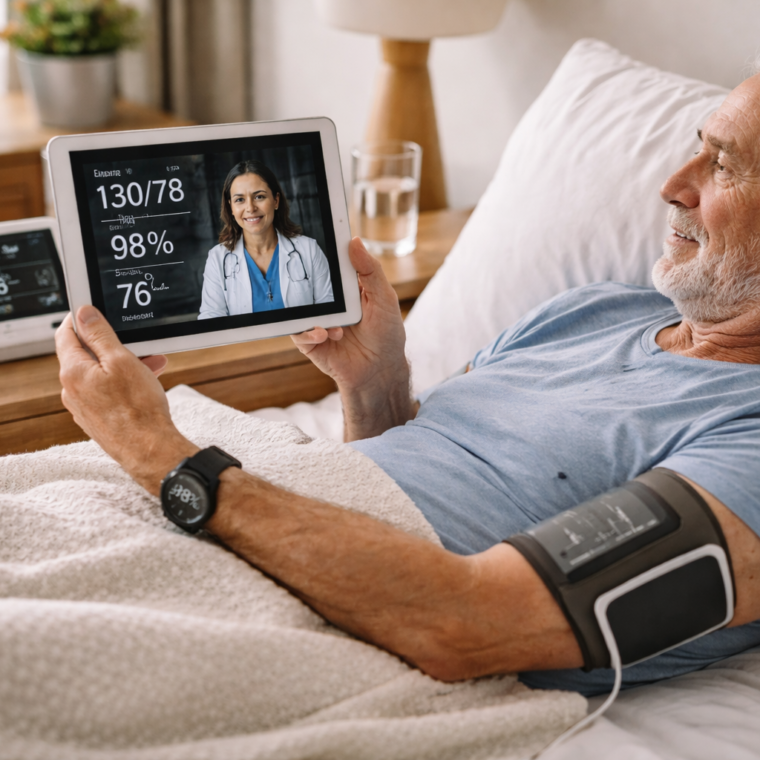
What if the future of hospitalization isn’t building more beds… but monitoring patients in their own living rooms?
The global trend: “Hospital-at-Home” is no longer a pilot—it’s a capacity strategy
In England, the NHS calls it virtual wards (often referred to as hospital at home):
hospital-level care delivered at home, supported by remote monitoring and clinical
follow-up. (NHS England)
In the U.S., CMS launched the Acute Hospital Care at Home (AHCAH) initiative, enabling hospitals to provide acute-level care in the home under a defined regulatory framework. (CMS)
Executive translation: a “hospital without walls” is already on the roadmap of serious health systems—because it’s a direct response to the bed bottleneck.
The thesis: the future of hospitalization isn’t more infrastructure… it’s better orchestration
Building beds is CAPEX + time + staffing + maintenance.
By contrast, Hospital-at-Home is “elastic capacity”: when designed properly, it allows certain acute patients to be treated safely at home through:
- remote monitoring (vitals and symptoms)
- scheduled in-home visits
- video consults
- logistics coordination (meds, equipment, escalation pathways) (CNIB)
But let’s be clear: this isn’t “telemedicine with steroids.” It’s hospitalization, with protocols, patient selection criteria, and 24/7 response capability.
Does it work? Regulators and evidence are converging on outcomes + safety
CMS released a fact sheet summarizing findings from its AHCAH study, reporting that overall beneficiaries treated under the program experienced lower mortality compared with similar beneficiaries treated in traditional inpatient settings, consistent with prior Hospital-at-Home literature. (CMS)
Meanwhile, major providers like Mayo Clinic describe their Advanced Care at Home model and its operational scale, positioning it as “hospital-quality care at home,” supported by a command-center approach. (Mayo Clinic)
Translation: the question is no longer “Can it be done?” The question is “Is your infrastructure ready to do it well?”
The real challenge isn’t clinical—it’s infrastructure, data, and continuity
A “hospital without walls” fails when:
- remote patient data arrives late (or doesn’t arrive)
- clinical teams lack a unified view of the patient
- there’s no traceability for decisions, alerts, and escalation
- the operation runs on patches (WhatsApp + spreadsheets + calls + PDFs)
Inside the building, the patient is “in the system” by proximity. At home, the patient is inside your system only if your technology can follow them.
2026 checklist: the minimum infrastructure for Hospital-at-Home
1) Architecture built to operate beyond the perimeter
Your stack must support secure access, high availability, and continuity outside the hospital network.
2) Remote Patient Monitoring (RPM) data integration
Hospital-at-Home programs commonly rely on remote monitoring devices and digital pathways to share data and coordinate care. (CNIB)
3) A clinical command center
It’s not enough to “see data.” You need an operation that turns signals into actions:
- thresholds
- alerts
- escalation
- condition-based protocols
4) Interoperability and traceability
The record must consolidate relevant information (episode context, meds, vitals, alerts, progress) without copy-paste workflows.
5) Security and governance
Because extending the hospital beyond its walls also expands your risk surface.
“Hospital without walls” in financial terms: capacity, throughput, and efficiency
This isn’t about being trendy. It maps to real pressures:
- bed saturation
- length-of-stay costs
- healthcare-associated infections
- demand for new care modalities
And the market is moving with it: the broader ecosystem of home-based care and enabling technologies (monitoring, in-home services, digital platforms) is projected to grow strongly over the coming years. For example, Fortune Business Insights projects growth in the global home healthcare market through 2032.
(fortunebusinessinsights.com)
Where HarmoniMD fits: if your HIS is cloud-ready, your hospital can “leave the building”
This is where Hospital-at-Home stops being a slide deck and becomes implementable.
HarmoniMD (cloud-ready HIS/EHR)
HarmoniMD positions itself as a cloud-based HIS/EHR, with a focus on continuity and capabilities that support digital operations at scale. (Harmoni MD)
Additionally, technical content from the HarmoniMD ecosystem describes an architecture with access controls, encryption, and connectors (HL7/FHIR) as part of industry practices. (Harmoni MD)
Translation: if your clinical record and operations are designed for secure, multi-site access, you’re much closer to monitoring patients outside the building without breaking clinical workflows.
CLARA: turning remote data into faster decisions
In a Hospital-at-Home model, the bottleneck isn’t “having data.” It’s interpreting it and acting in time. A clinical copilot like CLARA can help teams rapidly surface relevant context from the record and support faster clinical navigation when working with RPM signals, alerts, and changes in patient status. (Harmoni MD)
Conclusion: building beds is linear; building a hospital without walls is scalable
Hospital-at-Home doesn’t replace the hospital. It makes it smarter: reserving physical beds for those who truly need them, while extending clinical capacity to where the patient is.
The trend is already validated through regulatory initiatives and large-scale
adoption models (NHS virtual wards, CMS AHCAH). (NHS England)
The 2026 question is simple:
Can your infrastructure operate with patients outside the building without losing safety, traceability, and clinical control?
Book a demo and design your “Hospital Without Walls”
If you want to see how HarmoniMD (cloud-ready HIS) + CLARA can support a Hospital-at-Home model with remote data, continuity, and governance book a demo. book a demo.