



At 6:42 p.m., the patient has already paid at the cashier.
At 6:47 p.m., they received their medical instructions.
At 6:53 p.m., they left the hospital.
And this is where many marketing teams make the most expensive mistake in the
healthcare commercial cycle: they act as if the sale were over. It is not over.
In reality, the moment that defines true profitability is just beginning:
Will that patient come back when they need care?
Will they bring their partner, their children, their parents?
Or will you lose them because of digital friction?
Because the real hospital business is not only in the first transaction. It is in
retention, in Lifetime Value (LTV), and in the ability to turn one episode of care
into a relationship.
The Clinical Record Can Also Be a Growth Tool
Many hospitals still see the clinical record as a tool exclusively for physicians.
That perspective has already fallen short.
Today, the clinical record and the patient portal are also infrastructure for:
- loyalty,
- recurrence,
- recommendation,
- and permanence within the hospital ecosystem.
ASTP/HealthIT reported that in 2024, more than 3 out of 4 people in the U.S.
said they had been offered online access to their medical records, and that nearly
two-thirds accessed them at least once during the past year (healthit.gov).
That means digital access to medical history is no longer “nice to have.”
It is becoming a baseline expectation.
Hospital Marketing Does Not End at the Cashier; the Real Money Is in the
Return
When the patient leaves the hospital, your institution has two paths:
Path 1: Transactional Relationship
- the patient leaves,
- stores papers,
- loses results,
- starts from scratch somewhere else.
Path 2: Continuous Relationship
- the patient keeps access to their medical history,
- reviews results,
- sees upcoming appointments,
- interacts with the hospital through a connected channel,
- and has fewer incentives to “break” the relationship.
That is retention.
And retention is what makes CAC make sense and LTV grow.
A Poor Digital Experience Really Does Make Patients Switch Providers
Here is the point that hits Marketing and Patient Experience directly.
Cedar reported that 41% of consumers would consider no longer visiting their
provider because of a poor digital experience, and that nearly 1 in 5 had already
done so at the time of the study (cedar.com).
Fierce Healthcare highlighted the same finding and emphasized that younger
patients were even more likely to switch because of digital friction
(fiercehealthcare.com).
Executive translation: digital experience already has a direct impact on patient
leakage. It is not a cosmetic issue. It is a future revenue issue.
When the Portal Stops Being an “Extra” and Becomes a Loyalty Ecosystem
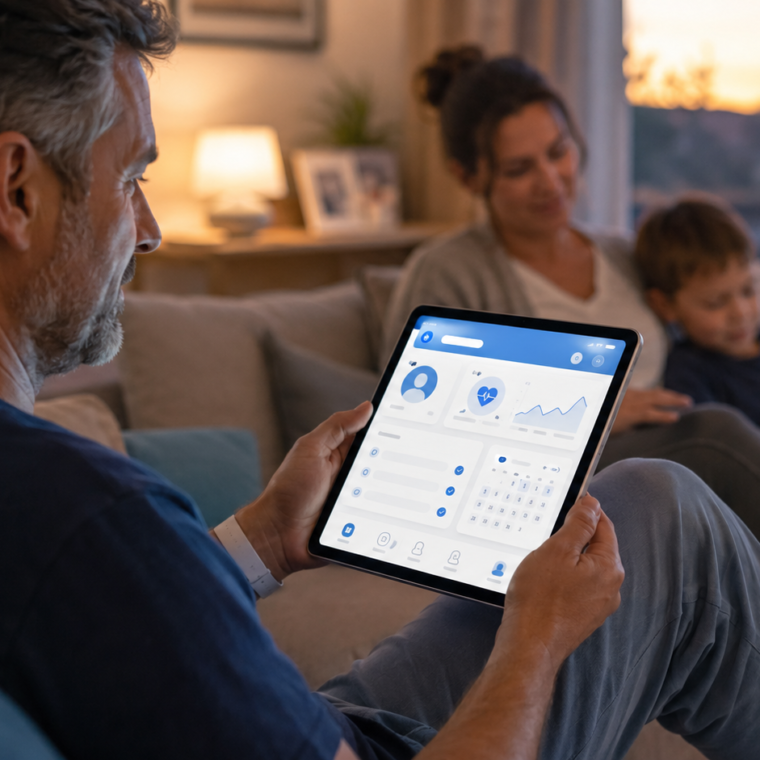
A well-implemented patient portal is not just a place where you “upload results.”
It is a central piece of the permanence ecosystem.
Patient portals often include functions such as:
- access to medical history,
- results visualization,
- clinical notes,
- secure messaging,
- scheduling or upcoming appointments,
- requests and follow-up. (pmc.ncbi.nlm.nih.gov) (pubmed.ncbi.nlm.nih.gov)
And that matters because, according to systematic reviews, patient portals can
improve:
- patient engagement,
- adherence,
- patient-provider communication,
- and even patient satisfaction in some contexts (pmc.ncbi.nlm.nih.gov)
(pubmed.ncbi.nlm.nih.gov).
The more useful your portal becomes, the “stickier” the relationship with your
hospital becomes.
The LTV Logic in Healthcare: Continuity + Convenience + Trust
The patient does not return just because they “liked” the hospital.
They return when three conditions are met:
1) Continuity
If their information is already organized, accessible, and alive within the system,
switching providers means starting over.
2) Convenience
If they can review results, notes, and upcoming appointments without chasing
anyone, friction goes down.
3) Trust
If the portal allows them to see their information, better understand their care
process, and feel supported, the relationship gains depth.
National evidence in the U.S. also shows that when patients are encouraged by
their provider to use the portal, usage increases significantly: in 2024, 87% of
those who were encouraged accessed the portal at least once, compared with 57%
of those who did not receive that encouragement (healthit.gov).
Translation for CMOs: the portal is not adopted just because it exists. It must also
be designed as part of the journey.
The Growth Loop Many Hospitals Are Ignoring
A connected portal can create a virtuous cycle:
1. the patient receives care,
2. gains immediate access to results and medical history,
3. perceives continuity and order,
4. schedules or manages their next interaction with less friction,
5. recommends or brings their family into the same system.
Cedar also reported that 65% of consumers would be very likely to recommend a
provider or write a good review if they receive a great digital experience
(cedar.com).
That is no longer just retention. It is organic acquisition leveraged by experience.
The Family Also Enters the Game: The Portal Does Not Only Retain Individuals; It Retains Care Environments
There is an underused layer here.
ASTP/HealthIT reported that proxy or caregiver access more than doubled
between 2020 and 2024, increasing from 24% to 51% (healthit.gov).
This is powerful because in healthcare, the decision is not always made by an
isolated individual.
Many times, it is made by a family, a caregiver, or a close network.
Translation for Patient Experience: when the digital ecosystem works, you do
not only retain “one patient.” You retain their circle of influence.
The Strategic Mistake: Thinking the Portal Is a “Feature” and Not a “Strategy”
Many hospitals implement a portal as a project checklist item:
- “we already have a portal,”
- “we already upload results,”
- “access already exists.”
But the right question is not whether it exists.
The question is whether it generates recurrence.
Because if the portal:
- is difficult to use,
- does not contain useful information,
- does not work on mobile,
- or is not connected to the patient’s real workflow, then it does not build loyalty.
It only builds frustration.
And recent literature on the use of the NHS App in England shows precisely how
portal use is linked to variables such as access, ease of use, and user context —
not only the existence of the system (jmir.org).
HarmoniMD: The Portal as a Commercial Extension of the HIS
This is where HarmoniMD’s approach has an interesting reading for Growth.
Si el portal está conectado de verdad al núcleo clínico del hospital, entonces deja de ser “un front bonito” y se convierte en una extensión operativa y comercial del HIS.
HarmoniMD positions itself as a clinical and administrative platform with
information, follow-up, and digital access capabilities within the patient ecosystem
(harmonimd.com) (harmonimd.com).
And the Growth logic is clear:
- immediate access to medical history,
- connected results,
- visible future appointments,
- continuous relationship with the hospital,
- higher probability of return,
- higher probability of recommendation.
The portal does not only improve the patient experience. It also improves the
likelihood that the patient will come back.
How to Know Whether Your Portal Is Retaining… or Just Decorating
Ask yourself these questions:
1. Can the patient easily view their medical history, results, and upcoming
appointments?
2. Is the portal actually used after care, or does it only exist in theory?
3. Does your clinical/promotion team actively encourage the patient to use it?
4. Does the portal work as a simple mobile experience, or as another digital
barrier?
5. Can you measure whether portal users return more often or recommend
more?
6. Is your portal connected to the HIS, or does it work like a “pretty island” with
no real impact?
If you cannot answer with data, you are probably underusing your best retention
asset.
Your Best Sales Engine Is Not in Paid Media; It Is in Continuity
In 2026, the hospital marketing that wins is not the one that only fills the top of the
funnel.
It is the one that turns one episode of care into a long-term relationship.
The evidence already shows that:
- digital access to records and portals continues to grow (healthit.gov),
- patients really do switch providers because of poor digital experiences
(cedar.com), - and patient portals can improve engagement, communication, and
satisfaction (pmc.ncbi.nlm.nih.gov) (pubmed.ncbi.nlm.nih.gov).
That is why the clinical record should no longer be seen only as a tool for
physicians. When well connected, well designed, and well activated, it can also become a
retention machine.
Because when the patient feels that their story already lives with you, switching
hospitals stops being a simple decision.
If you want to see how HarmoniMD can help you turn the Patient Portal into a real
lever for retention, LTV, and loyalty, schedule a demo.
We will review with you how connected your post-consultation journey is today,
where continuity is being lost, and how to transform your clinical software into a
real growth engine (harmonimd.com) (harmonimd.com).