


If 2024 made anything clear, it’s that cybersecurity and modernization are no longer “someday” projects. On average, each data breach cost organizations USD $4.88 million, a record high driven by hybrid complexity and poor visibility into what data actually move around the enterprise. ( cdn.table.media )
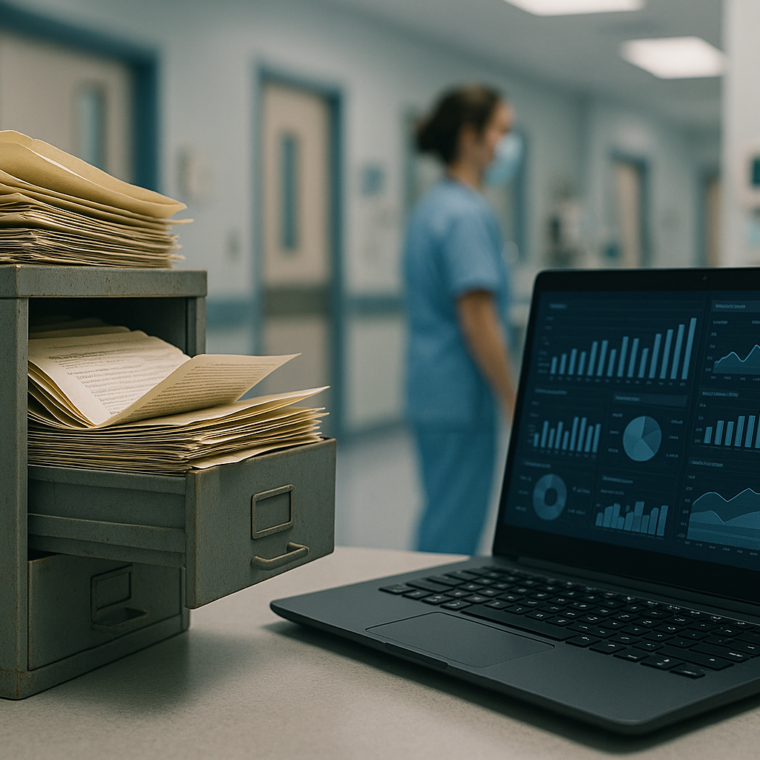
At the same time, ransomware pressure in LATAM keeps climbing: Thales’ Data Threat Report 2024 – Latin America notes that 29% of organizations suffered an attack (up from 21% the prior year), and multiple sources show the region’s exposure is still rising. The message is unambiguous: it’s time to accelerate the shift from paper hospitals to data hospitals. (cpl.thalesgroup.com)
2025 snapshot: budgets, threats, and the urgency to modernize
- Ransomware is up across the region. CrowdStrike observed a +15% increase in LATAM victims listed on extortion/ransomware leak sites from 2023 to 2024; Mexico concentrated more than half of regional cyber
incidents reported in H1-2024, reflecting the pull of nearshoring and expanded supply chains. (crowdstrike.com) - The real cost of “not seeing” your data. IBM reports the global average breach climbed to USD $4.88M, and “shadow data” (information outside IT/security oversight) appeared in about 1 in 3 breaches, inflating
response and recovery costs. ( cdn.table.media ) - Legacy tech = operational risk. Dependence on end-of-life infrastructure increases vulnerabilities; industry voices warn that “the old gear that still works” carries hidden security costs, amplified by attackers already using AI. (WIRED)
- Public policy is advancing—unevenly. PAHO/WHO shows regional progress on the digital transformation roadmap for health (EHR, telehealth, data governance), but with asymmetries that translate into
adoption and capability gaps. (Organización Panamericana de la Salud)
Paper hospitals: the price of operating “blind”
- Financial risk. Each incident disrupts care, erodes trust, and triggers notification, forensics, and recovery costs—hence the USD $4.88M per breach average. ( cdn.table.media )
- Shadow data & unapproved apps. Without continuous discovery and classification, part of the clinical/operational information sits outside control, and roughly 35% of analyzed breaches involved this kind of “in- the-shadows” data. ( cdn.table.media )
- Aging systems. End-of-life equipment and configurations keep things running… until they don’t—or until they’re exploited. Modernization isn’t “IT vanity”; it’s clinical-financial risk management. (WIRED)
Data hospitals: pillars to create (and protect) value
1. Data governance and visibility
Discover, classify, and protect sensitive information (including “shadow” data) across cloud, on-prem, and endpoints. IBM and other industry analyses consistently call for better visibility as the central lever to reduce
incident impact. (IBM)
2. Security by design (pragmatic Zero Trust)
Strong identity and access controls, encryption in transit/at rest,
management, and tested incident-response plans—a well-contained breach
costs less and recovers faster. (cpl.thalesgroup.com)
3. Effective interoperability
HL7/FHIR connectors and exchange KPIs (latency, completeness, error rates) so information flows across EHR, lab, imaging, and finance; without connected data, there’s no high-value analytics. (Aligned to PAHO’s regional
roadmap.) (Organización Panamericana de la Salud)
4. Clinical-operational analytics and actionable boards
Run on near-real-time signals (ED, inpatient, OR): throughput, occupancy, length of stay, cycle times, denials, collections. Shifting from historical reports to alerts and worklists changes daily decisions. (Organización
Panamericana de la Salud)
5. Resilience and continuity
Plan and drill clinical RTO/RPO so a system outage doesn’t become a care crisis; with attacks rising in LATAM, downtime is a major component of total incident cost. (crowdstrike.com)
Where HarmoniMD + CLARA fit
- HarmoniMD delivers a cloud HIS/EHR, multi-device, with HL7 connectors and clinical-operational dashboards ready for performance and continuity metrics.
- CLARA (AI assistant) enables semantic discovery across the chart, traceable summaries, and note automation inside clinical workflows—no data exfiltration—and with governance to avoid “shadow AI.”
Conclusion
LATAM is at an inflection point: attackers won’t wait for the budget cycle, and breach costs keep breaking records. Moving from paper to data isn’t about “buying modules”; it’s about seeing, governing, and using information with security, interoperability, and analytics that shift clinical and financial outcomes. The hospitals that win aren’t the biggest spenders—they’re the ones that prioritize visibility, resilience, and execution.
Want to see this in your workflows?
Book a HarmoniMD + CLARA demo or let’s discuss your project. We can map risks, light up dashboards, and measure impact on continuity, quality, and margin.