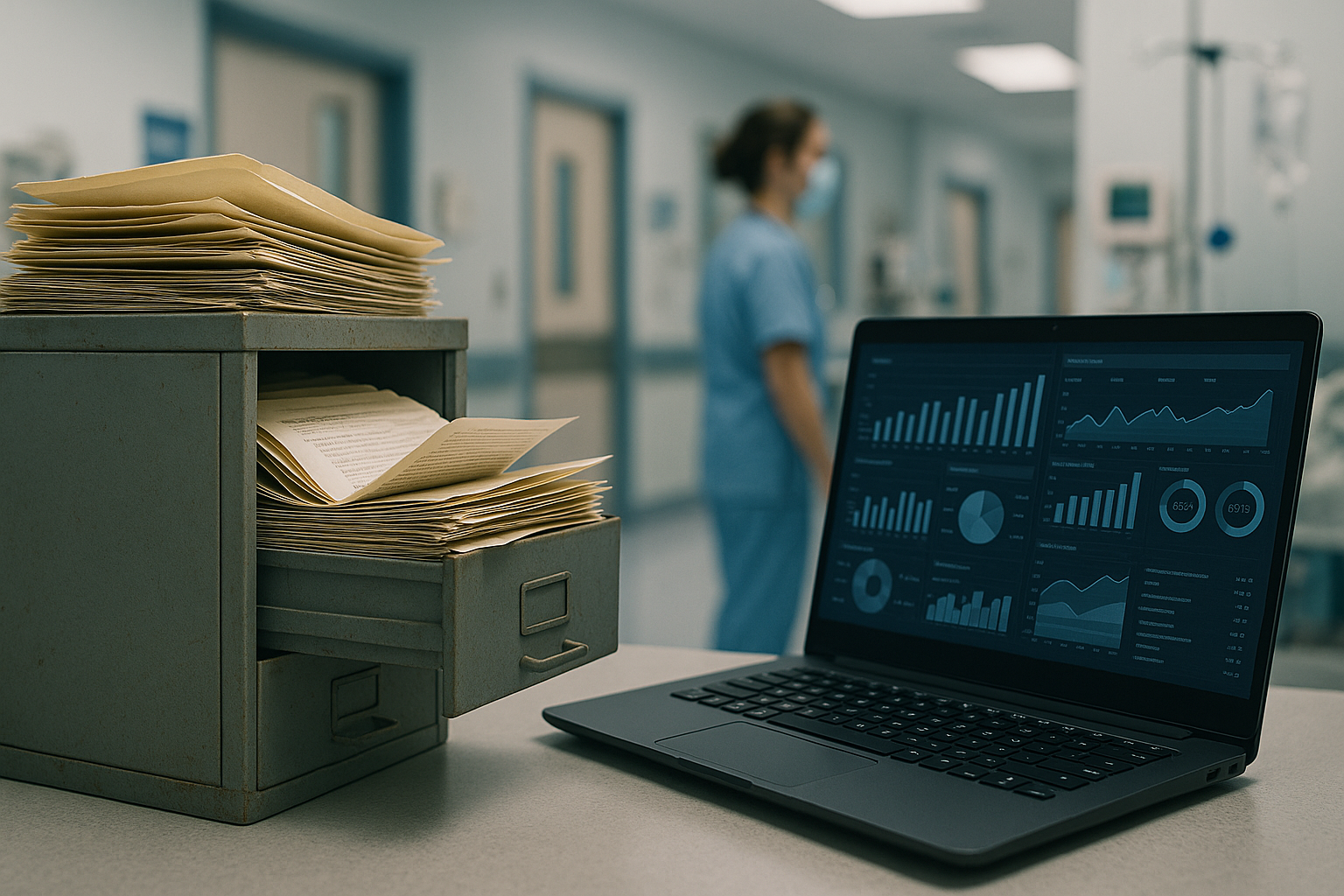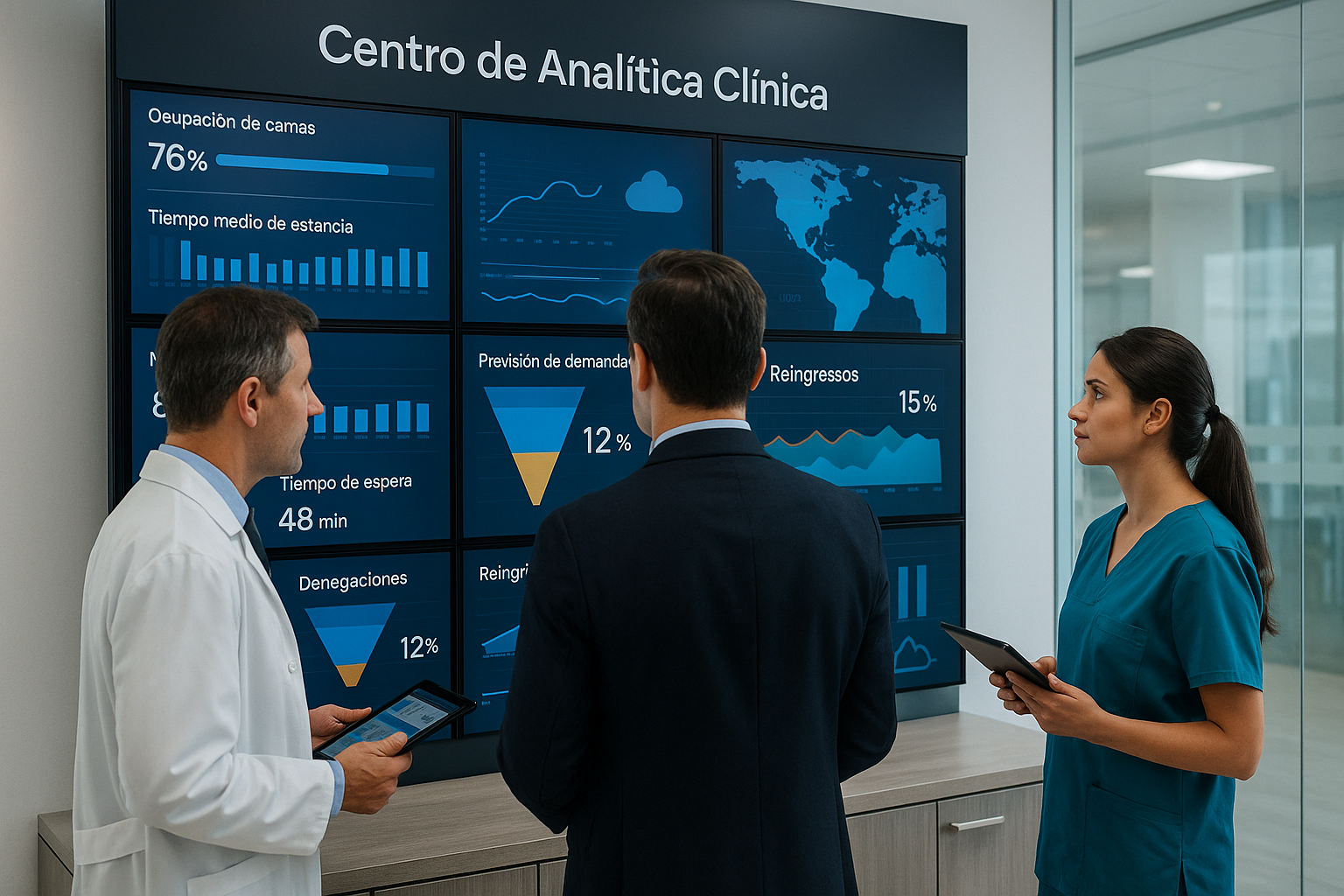




At 6:58 a.m., the first patient is already waiting.
The physician walks in, greets them, listens… and then the plot twist hits: the chair turns toward the computer, the EHR opens, and the click-marathon begins—problem list, note, orders, justification, templates, copy-paste, “required fields”… while the patient gets a front-row seat to the back of the doctor’s head.
Here’s the uncomfortable (but highly profitable) question: How much medical talent are you losing because your specialists spend 40% of their shift typing?
This isn’t just a vibe. A systematic review found physicians spend about 37% of their workday interacting with the EHR. (PMC) And a landmark Annals of Internal Medicine time-motion study reported physicians
spent 49.2% of their clinic day on EHR + desk work (vs 27% face-to-face clinical time). (acpjournals.org)
Cultural translation: when the system forces “capture,” doctors don’t feel like clinicians. They feel like expensive administrative assistants.
The thesis: technology shouldn’t “help you document faster”… it should eliminate documentation
For years, the pitch was: “Here are templates, macros, shortcuts—document faster.”
That’s like telling your CFO: “Don’t worry, we optimized Excel so you can enter invoices faster.” No. The goal isn’t to accelerate pain. The goal is to remove it.
In 2026, redesigning the physician role means shifting to:
- Physicians stop being data entry operators
- They become clinical validators: review, correct, sign, decide
- While capture is automated, reused, or orchestrated by the care team
This isn’t ideological—it’s operational. Evidence suggests team-based documentation can reduce documentation/EHR time and may even be associated with higher visit volume after an adjustment period. (JAMA Network)
The real problem isn’t “the EHR”: it’s clerical work that crept into medicine
The EHR doesn’t “steal time” simply by existing. It steals time when it:
- forces clinicians to retype data that already exists elsewhere
- fragments workflows (lab, imaging, pharmacy, admissions, notes)
- punishes visits with “required fields” without contextual intelligence
- turns clinical thinking into paperwork
And this hits well-being directly. Even with signs of improvement, burnout remains high: AMA data show that in 2024, 43.2% of physicians reported at least one symptom of burnout. (American Medical Association)
Administrative burden and after-hours work continue to be central in how the issue
is addressed. (American Medical Association)
Culture translation: as long as physicians feel their job is “feeding the system,”
your organization pays—in turnover, frustration, and productivity loss—no matter
how “good” your software is.
Interoperability: the antidote to “writing the same thing five times”
This is where the conversation gets serious (and finally useful).
Interoperability means systems can securely and timely access, exchange,
and integrate data, so information is usable where it’s needed. (IBM)
Standards like HL7 FHIR exist specifically to enable electronic exchange of health
information and advance interoperability. (ecqi.healthit.gov)
Day-to-day translation for clinicians:
- if the data already exists, don’t re-enter it
- consume it, contextualize it, and validate it
- physicians decide… they don’t transcribe
2026 blueprint: how to rewrite the physician job description (without setting
IT on fire)
If you want to kill the “data-entry doctor” role without chaos, you need five moves:
1) Separate capture vs validation
- Capture: automation / team / orchestration
- Validation: physician (clinical judgment + signature)
2) Team-based documentation (where it makes sense)
- structured support workflows (assistants, scribes, coordination)
- clear role boundaries + measurable outcomes
Evidence shows potential benefits in documentation time. (JAMA Network)
3) Interoperability for data reuse
- labs, history, meds, allergies, diagnoses: integrate once, reuse
everywhere - clinical notes stop being “copy-paste across screens” (ecqi.healthit.gov)
4) Clinical AI as a copilot, not a “faster keyboard”
- AI to prefill, suggest, summarize, and structure
- physicians edit and validate (human control stays in the loop)
5) Measure the “documentation tax” as an institutional KPI
Because what you don’t measure becomes culture.
Minimum metrics (first 60 days)
- % physician time spent in the EHR (during shift)
- average time to close notes
- after-hours “pajama time”
- physician satisfaction with workflow (yes, this is a KPI)
- turnover / intent to leave (if it’s already visible, you’re late)
(For magnitude: studies consistently document substantial proportions of the day in
EHR and desk work.) (PMC)
Where HarmoniMD + CLARA fit: from “capture everything” to “validate and
decide”
The goal isn’t to make physicians “type faster.” The goal is to make them type
less.
HarmoniMD (HIS)
- A well-integrated HIS reduces friction by aligning clinical and administrative
workflows (less duplication, fewer internal loops). - The foundation for eliminating capture is that information exists with traceability
and can be reused.
CLARA (clinical copilot)
In the right model, CLARA enables physicians to:
- quickly retrieve and synthesize context from the record
- generate drafts (notes/summaries) for review
- validate data instead of writing from scratch
And when this is supported by real interoperability (not “export a PDF”), the
physician shifts from capturing to confirming and deciding. (ecqi.healthit.gov)
Conclusion: manual documentation isn’t efficiency—it’s talent leakage
In 2026, the “data-entry doctor” isn’t a role—it’s a symptom.
A symptom that the organization designed the system to feed screens, not to
protect clinical time.
The data is clear: across studies, a large share of the day goes to the EHR and
desk work. (PMC)
And while burnout has improved, a significant portion of physicians still report
symptoms. (American Medical Association)
The strategic move is to redesign the job: physicians become expert
validators—not institutional typists.
Book a demo—and let’s redesign your clinical workflow (no fluff)
If you want to see how HarmoniMD + CLARA can help you reduce
documentation, improve continuity, and give physicians time back where it
matters, book a demo.