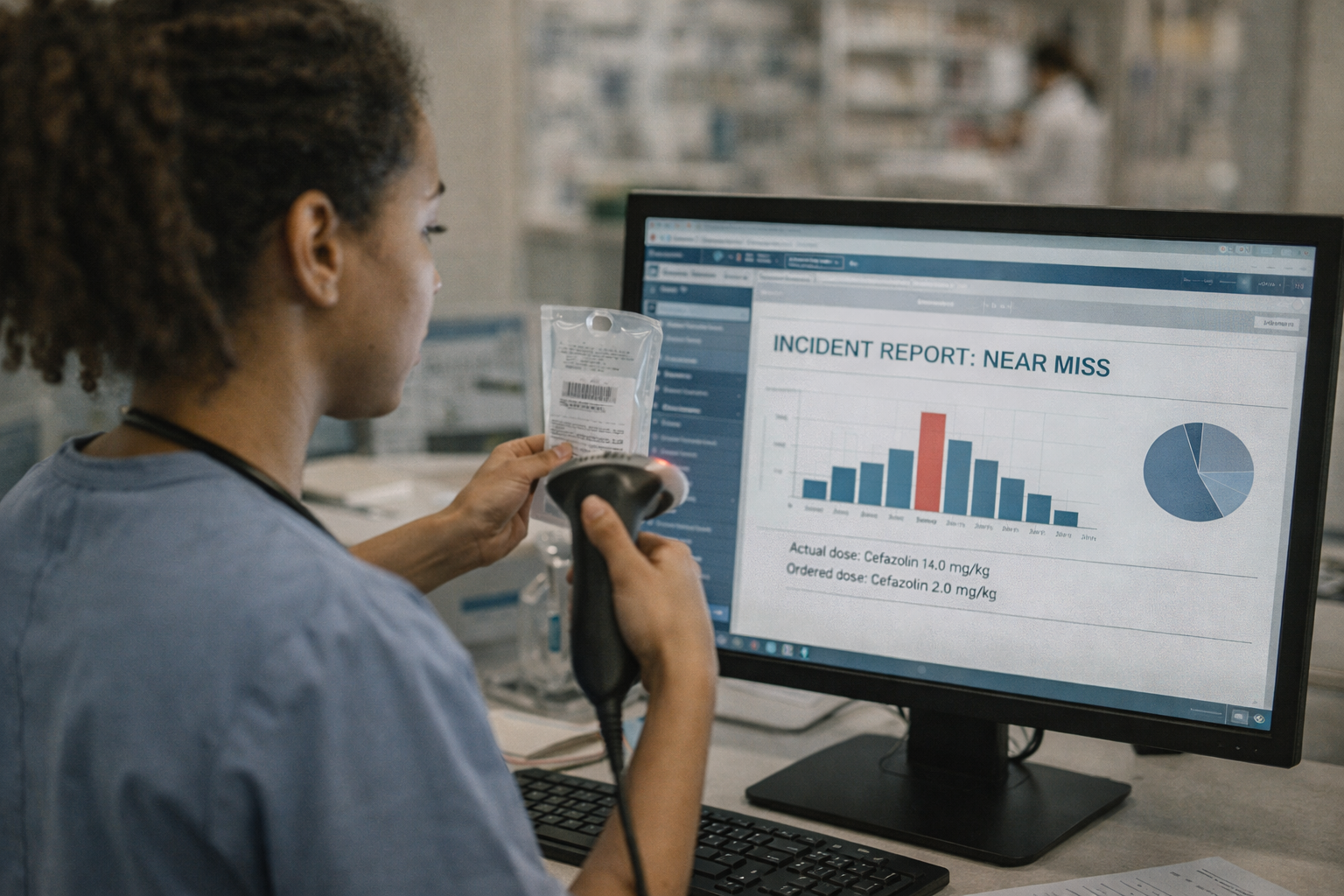




Picture the night shift: one nurse, ten patients, alarms chirping, handoffs in motion, new orders flowing in. The “five rights” (right patient, drug, dose, route, time)help, yes… but they’re no longer sufficient in such complex environments. The evidence is stark: medication-related harm affects 1 in every 30 patients and
costs roughly USD $42 billion per year worldwide—a drag on both patient safety and hospital finances. (Organización Mundial de la Salud)
The real problem lives at the point of administration
While errors occur in prescribing, transcribing, and dispensing, over 30% happen during administration. That’s precisely where BCMA (barcode medication administration—scanning the patient wristband and the medication) breaks the error chain, verifying in seconds that what will be given matches the active order.
The “five rights” are a goal, not a method
Patient-safety literature is clear: the “five rights” do not, on their own, guarantee safety. Medication administration is a system process that needs design, technology, and robust workflows (e.g., scanning, independent double-checks for high-alert meds, smart pumps). (psnet.ahrq.gov)
What BCMA is—and how it works
BCMA links the patient wristband and the drug barcode to the EHR/eMAR:
- Scan the wristband (right patient).
- Scan the medication (right drug/dose/route/time).
- Auto-document in the EHR, reducing manual transcription and delays.
The evidence: BCMA reduces errors (and potential harm)
- In an academic hospital, BCMA + eMAR achieved a 41% relative reduction in non-timing administration errors and a 50.8% reduction in potential adverse drug events; transcription errors fell to zero. (NEJM
study, Poon et al.) (PubMed) - 2024 summaries (Leapfrog) reaffirm BCMA as a best-practice standard, with specific guardrails to reduce workarounds and raise compliance.
Operational translation: BCMA turns the “five rights” from an individual reminder into a system-level quality check at every administration. (psnet.ahrq.gov)
It’s not “just the tech”: the how matters
Poorly implemented BCMA can create friction and workarounds that raise risk. Adoption must come with workflow redesign, training, and active measurement of scanning compliance (patient and medication). (PMC)
What a mature BCMA program requires (best practices)
- Coverage across 100% of units (med-surg, ICU, OB, pre/post-anesthesia).
- ≥95% of administrations with dual scanning (patient and medication).
- Decision support at the point of care (salient alerts, reconciliation).
- Anti-workaround processes: clinical leadership, audits, continuous feedback.
The business case: safety that pays
Leapfrog’s fact sheet estimates avoiding one harmful error via BCMA costs about USD $2,000, less than the average cost of a harmful error (USD $3,100–$7,400). Add impacts on LOS, litigation, and reputation, and the equation is unambiguous.
Day-one metrics to watch
- % of administrations with dual scanning (target ≥95%).
- Administration errors per 1,000 doses and potential ADEs (baseline vs. month 3/6). (PubMed)
- Compliance by shift/unit and documented workaround events (and fixes). (psnet.ahrq.gov)
Where HarmoniMD + CLARA fit
- HarmoniMD integrates BCMA with cloud eMAR/EHR and dashboards for scan compliance, alerts, and full traceability.
- CLARA (clinical AI) summarizes active orders, highlights
allergies/interactions, and assists documentation inside the HER no “shadow AI.” The value isn’t just “scanning”; it’s making better decisions with context.
Conclusion
Patient safety isn’t solved by memory or goodwill. In 2025, the standard is automated verification at the bedside—turning a mnemonic into a real technical barrier against medication errors. Properly implemented and measured, BCMA is one of the highest-ROI clinical-operational investments a hospital can make. Ready for the next step?
Book a HarmoniMD + CLARA demo, or let’s discuss your project and map a BCMA rollout aligned to best practices, metrics, and training.